
 Free Delivery on orders over £40*
 Give a friend 25% off their first order
 Highly rated by our customers

- Blog
- Campbells Blog
- A guide to Burns Night food, origins and more
A guide to Burns Night food, origins and more
Burns Night is a traditional Scottish celebration that marks the birthday of Robert Burns, born in 1759. It combines delicious Scottish food, whisky, music and poetry in a one-of-a-kind celebration.
What is Burns Night?
Burns Night is a real opportunity or even an excuse for a Scottish celebration. Across Scotland, people get together with friends and family for a Burns Supper. There are big events and small parties at home.
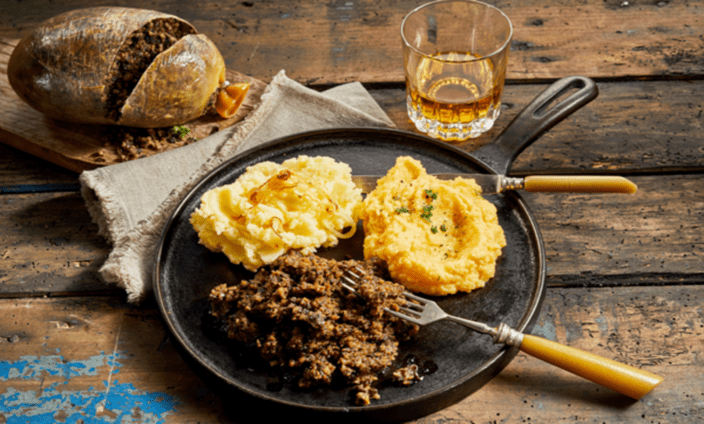
At the centre of any Burns Night celebration is the haggis, “the chieftain o’ the pudding race”, but what are the origins of Burns Night? And what is the relationship between Haggis and Burns? From the traditionally served haggis, neeps, and tatties, to more modern interpretations of Scottish fayre that are often presented such as Crispy Fried Haggis with Chilli Dipping Sauce or Crispy Haggis Rosti with Scallops as canapés, how did the event come about?
When is Burns Night?
Burns Night is on the 25th January every year and is one of the most uniquely Scottish events in the Caledonian calendar that is celebrated by most Scots at home, abroad, and the Scottish diaspora across the world.
What is the history of Burns Night?
Burns Night itself is named after the most popular and well-known national poet of Scotland, Robert Burns (also colloquially known in Scots as ‘Rabbie Burns’). Robert Burns was one of the most influential Scots writers who has ever lived and is famed for his use of the Scots’ language, as well as his deeply personal poetry that is often viewed as an early example of the Romantic Movement.
His poems and lyrics are known to many Scots and beyond, especially ‘Auld Lang Syne’, ‘Ae Fond Kiss’, ‘To a Mouse’, ‘Tam o’ Shanter’, and ‘A Red Red Rose’.
In 1801, five years after his death in 1796, a few friends of Burns held what would become the first Burns Night Supper on Robert Burns’ birthday. Nowadays, there are many types of Burns Night celebrations held, from the formal to the informal.
Traditionally, Burns Night consists of the recitation of several poems by Burns, the most important of which is the ‘Address to the Haggis’, where the Haggis is normally piped in by a bagpiper, a poem is recited to the Haggis, and then the Haggis is cut open by the main speaker in a ceremonious fashion.
Elements of these traditions are still in use today, and in increasing numbers outside of Scotland in places where members of the Scottish diaspora have settled, including Canada, Australia, New Zealand, and the United States.
Whether you are new to Burns Night or a seasoned participant, we hope that you have an excellent Burns Night Supper this year.
What is the history of the Haggis?
Haggis is the national dish of Scotland. The first mention of the Haggis in Scotland is actually within an English cookbook, the Liber Cure Cocorum, that dates back to 1430. It describes the Haggis as being made from sheep offal, mixed with oats and suet, which is cooked by boiling it in the sheep’s stomach.
Some may find the description off-putting, but many that have tried Haggis describe the flavour as rich and savoury with a slight underlying sweetness.
As to the origins of this dish in Scotland, there are a few theories. One is that the Romans brought the idea to Scotland, as there are descriptions of a similar cooking technique. Another is that the dish was brought over by the Scandinavians.
Yet another theory is that the Haggis simply developed as a way of utilising every part of a hunt without having to carry any extra cooking equipment, and this attitude of ‘waste not, want not’ is still a familiar fixture for many Scots today.
Whatever the case, while other countries have similar recipes the Haggis as we know it today is a completely Scottish invention. Modern Haggis is often made with the addition of stock and a variety of spices. Our own Chieftain Haggis is made from a Campbell family recipe that dates back to 1910.
Burns Night food and recipes
As well as traditional Haggis, a Burns Night Supper often consists of a variety of different Scottish produce and traditional dishes, including smoked fish, cheeses, and of course, a generous amount of whisky.
Our favourite Burns Night recipes include:
- Crispy Haggis Rosti with Scallops – a tasty starter with a unique blend of flavours
- Classic Haggis, Neeps and Tatties with Whisky Gravy – for a traditional main that’s sure to impress
- Scottish Sausage Casserole Recipe – a warming Scottish favourite, perfect for January
- Peppered Fillet of Beef with Whisky Sauce – a lovely twist on a Scottish classic
And for a truly unique combination of cultures, why not try out our Haggis Pakora recipe below:
Haggis Pakora Recipe
INGREDIENTS:
- 500g of haggis
- 300g of gram flour, also known as chickpea flour
- 250ml of water, or as needed
- 2 tsps of cumin seeds, or ground cumin
- 1 tsp of red chilli powder, or a smaller amount for less heat
- 2 tsps of ground coriander
- 2 tsps of salt
- 1 large red onion, finely chopped
- Oil for deep frying
- Two green chillies, chopped (optional)
METHOD:
- Mix all of the dry ingredients together (flour, spices, salt).
- Add your finely chopped red onion to the haggis. Mix well then roll into small balls.
- Add the water to the flour and spices slowly while stirring until you get a thick yet silky batter the same consistency as double cream.
- Heat up a lot of oil in a deep pan, you want enough that it can cover your pakora when frying. Test the temperature by adding a little bit of batter into the oil. It should rise to the top and turn golden, if it turns brown the oil is too hot and if it does not rise the oil is too cold.
- Add your haggis balls in batter one at a time, coat in the batter.
- Carefully place in the oil with a metal slotted spoon. Fry until a deep golden colour. Taste test and adjust your cooking time if needed.